


ReWildAR
Augmented Reality Installation by Tamiko Thiel and /p, 2021Commissioned for "FUTURES" 175th anniversary exhibit of the Smithsonian Institution, curator Ashley Molese, 2021.
Smithsonian American Art Museum acquires 1st edition of ReWildAR for its collection.
We are honored to announce the Smithsonian American Art Museum (SAAM) has acquired the 1st edition of ReWildAR! At the point when the first exhibit with ReWildAR is announced, its range will be extended from the AIB Arts and Industries Building to encompass the SAAM as well. Stay tuned!Thanks to Skylla and Lametta for help with the 3D plant modeling, and to Colin Wright for help with the 3D insect modeling and animation!
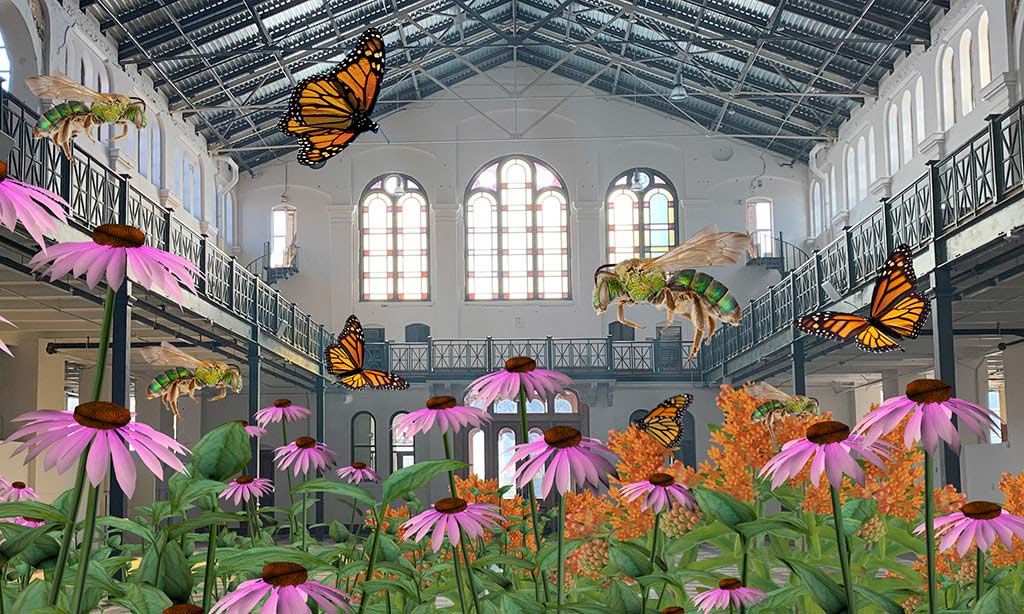
ReWildAR Visualization in AIB
For the 175th anniversary of the Smithsonian Institution, the exhibit "FUTURES" re-opened the Arts & Industry Building - the original US National Museum - after over a decade of renovations. With the motto "The future is not a fact—it is a decision," the exhibit challenged us to "imagine the future we want, not the future we fear."
ReWildAR recording of a walkthrough of the full installation in AIB
As part of the section "Futures that Inspire," ReWildAR offers a vision of how Washington D.C. can be rewilded to create a thriving, sustainable environment for nature in the city. It features native plants and insects that thrive all the way from Maine down to northern Florida, that therefore have a chance of surviving the vagarities of the rapid climate change to which we are subjecting our planet. In its new home in the Smithsonian American Art Museum, we imagine ReWildAR breaking out of the building and transforming the whole area into a wildflower meadow encompassing the White House and the National Mall!Rewilding the city means reimagining all available open areas and parks, but also planting strips, rooftops and other open spaces wherever possible, from sealed surfaces or carefully mono-cultivated gardens into wildflower meadows, wetlands or similarly biodiverse biotopes. This project specifically focuses on the symbiotic relationships between native flowers and insects that are necessary to preserve a diverse and healthy natural environment. This includes not just insects we love, like the Monarch butterfly, but insects that we might see as nuisances, such as large moths, and native wild bees that (unlike the imported European honey bee) produce no commercial benefit for us.
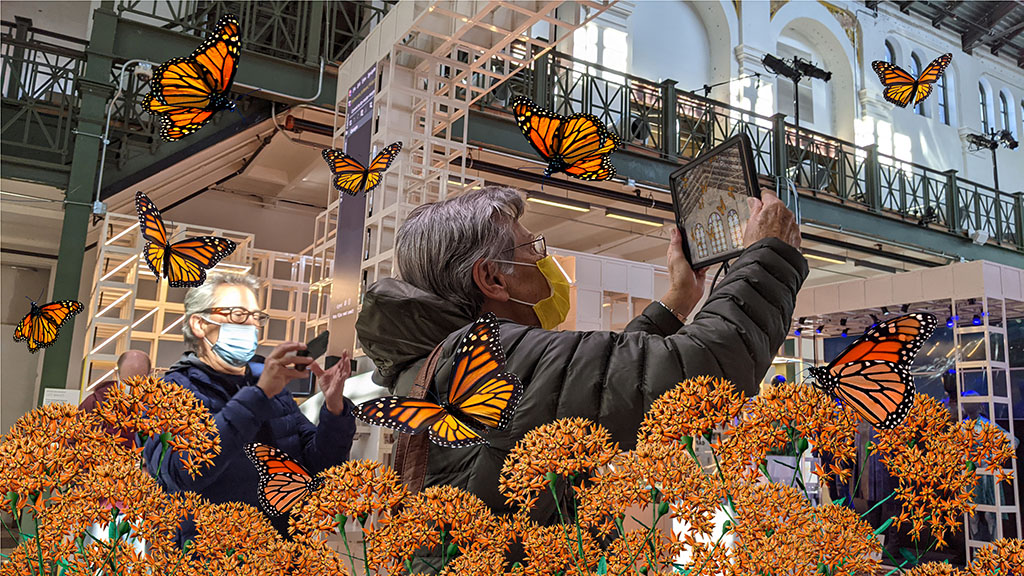
Visitors viewing ReWildAR on mobile devices. AR screenshot of milkweed/monarch butterflies scene.
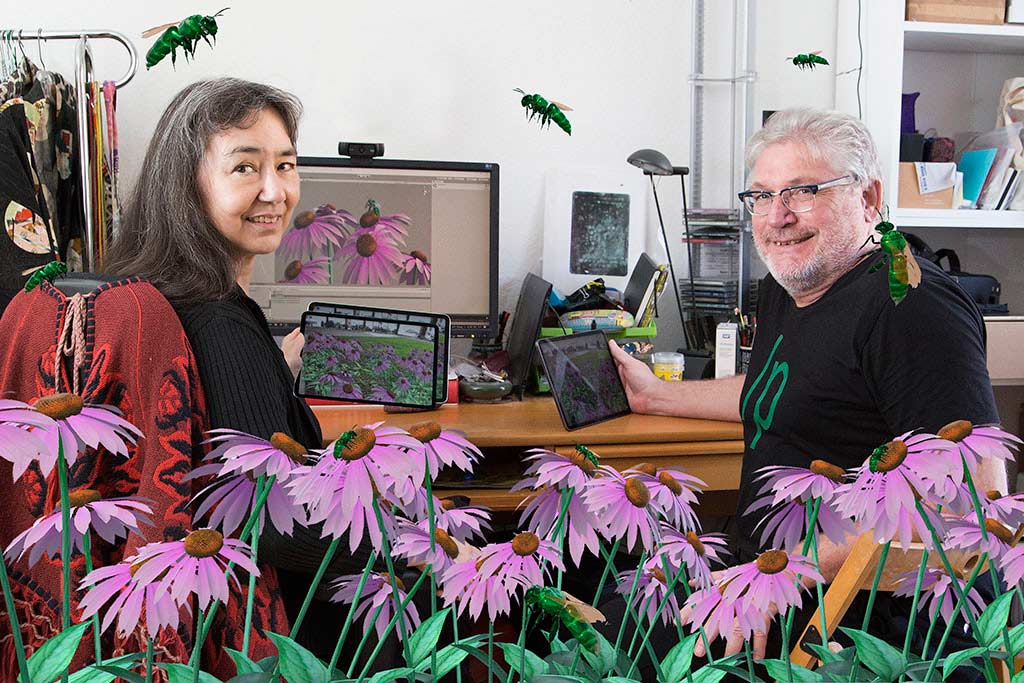
Tamiko Thiel and /p working on echinacea and sweat bees. With many thanks to Skylla and Lametta (3D plant modeling) and Colin Wright (3D insect modeling and animation)! Photo: Stefanie Gerstmayr
Project Background
We would first like to acknowledge that the Smithsonian buildings in which ReWildAR is sited, sit on the traditional territory of many nations past and present, including the Nacotchtank (Anacostan) and Piscataway Nations. The selection of plants in ReWildAR includes many that are traditionally important for these cultures, from which European-American systems of medicine have profited. In order to understand which plants could play a positive role in the future for the area, I first researched how climate change will affect the land on which the Smithsonian buildings stand, on and near to the National Mall in Washington DC. I found that they stand on a small rise, which will become a peninsula surrounded by wetlands as water levels rise, reverting to the landscape before arrival of European settlers.
Washington D.C. Mall with 10 feet surge
With help and advice from the Smithsonian Gardens horticulturists I then researched what plant and symbiotic insect pairs could be considered iconic for the area. I chose four pairs:
-
Dogwoods (Cornus florida) bloom on bare branches in early spring and are pollinated by short-haired dogwood mining bees (Andrena integra) that feed almost exclusively on dogwoods and one other plant.
-
Columbines (Aquilegia canadensis) come in late spring and attract white-lined sphinx moths (Hyles lineata) that, like hummingbirds, can hover in mid-air to drink nectar out of their narrow flowers.
-
Milkweed (Asclepias tuberosa) blooms in early summer, but from spring on, monarch butterflies (Danaus plexippus) need to lay their eggs on the plants as their caterpillars only feed on milkweed leaves.
- Echinacea (Echinacea purpurea) are depicted first in summer when they are visited by the super-pollinating metallic green sweat bees (genus Agapostemon), and then in winter as seed pods which (outside the scope of this artwork) provide vital food for birds in winter.