


ParadoQc/Machines
Augmented Reality livestream immersive installation, Tamiko Thiel and /p, 2025Commissioned by the ERES Foundation in celebration of the 2025 International Year of Quantum Science and Technology for their exhibition "Seeing the Unseen: Quantum physics and art as entangled worlds."
Exhibition: last days 03 - 26 September 2026, Thursdays and Saturdays only.
ERES Foundation main gallery, Römerstrasse 15, Munich, Germany
ParadoQc/Machines is an immersive installation that transforms quantum physics, the most abstract, paradoxical scientific domain we know today, into a personal phenomenological experience.
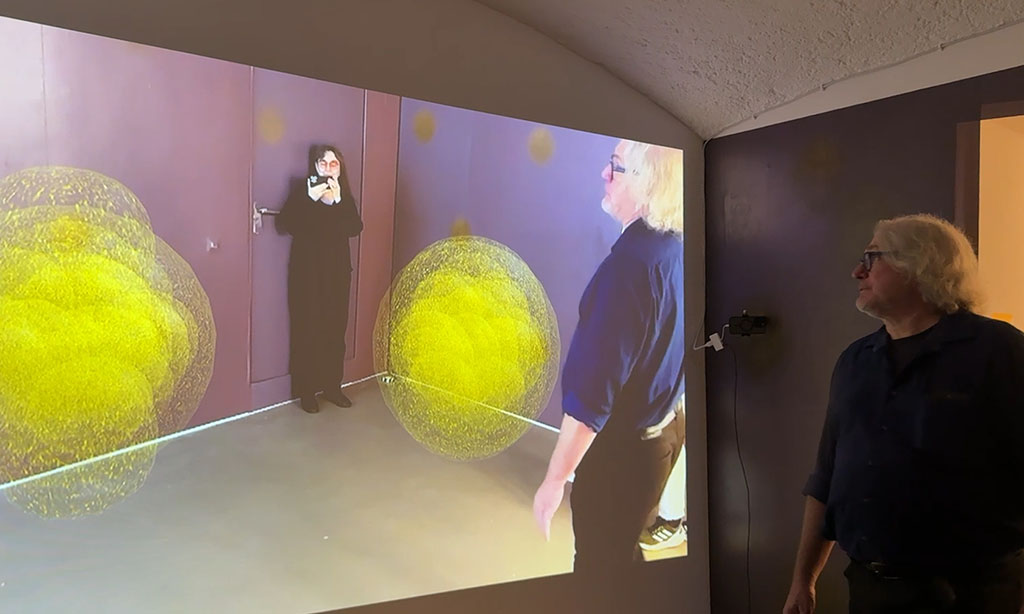
ParadoQc/Machines AR livestream immersive installation. Installation view, ERES Foundation, 2025. The AR livestream from the iPhone to the right of the screen is sent to the projector. Visitors see themselves inhabiting the quantum world.
Statement from quantum physicist Prof. Dr. Steffen Glaser, TU Munich:
"ParadoQc/Machines gives visitors an intuitive, full-body encounter faithfully reflecting the underlying quantum properties, informed by the artists' extensive research and engagement with leading scientists in the field."
Immersive yourself in a deep dive into the quantum levels of the atom, and how the quantum properties of superposition and entanglement are now used to build computers out of these quantum states. Although there are many types of quantum computers, we chose the neutral atom quantum computer as the subject of our artwork, as we can show these quantum properties clearly in the structures of the atoms and their electron probability clouds.
In the ERES Foundation, ParadoQc/Machines is being shown as a two-part exhibit. Part 1, shown above, takes visitors in a deep dive into the quantum levels of the electrons of a strontium atom, bringing these into superposition and entanglement.
We begin with macroscopic examples of quantum effects: a spiral galaxy, whose structure was formed by quantum fluctuations at the beginning of the universe. We dive into a star - the explosions of dying stars create heavier elements such as strontium, which accumulate with other elements stardust to form planets such as our earth. We dive into a strontianite crystal, whose structure is also a reflection of the quantum properties of its atom. We journey into a single strontium atom, through its quantum levels to the nucleus. Here it is easiest to see that we are in a shared 3-dimensional space where we can dance with the atoms!
We back out through the electron quantum orbitals: simple spherical orbitals, then more complex dumbbell and lobed shapes. Returning to the atomic level, we see how laser pulses turn atoms into "qubits" - exciting an electron into superposition between its "0" spherical base state and its "1" excited dumbbell shape. A double laser pulse entangles neighboring atoms into a 2 qubit unit, setting their electrons into exact opposite phases. This is how atoms are turned into the qubits of a quantum computer!
Part 2 shows how neutral atom quantum computers use these properties for repeatable calculations. It is shown in the ERES exhibit as a video above the model of the innermost chamber of a neutral atom quantum computer from the company planqc.
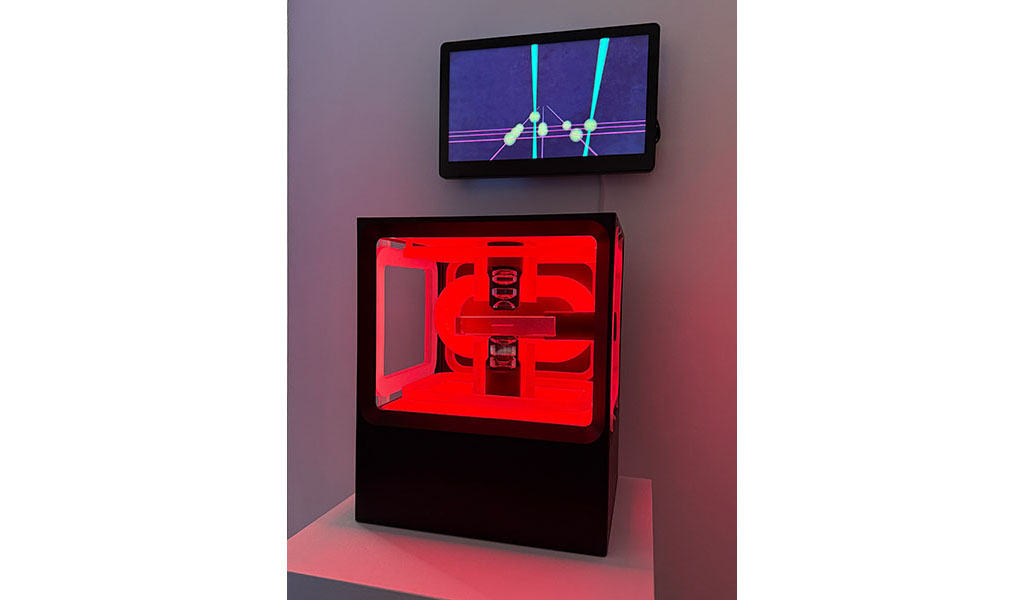
The video take us through the process of first cooling the atoms, trapping them in a lattice, and then exciting them with laser pulses into superposition and entangled states, which are the actual logical operations of a quantum computer.
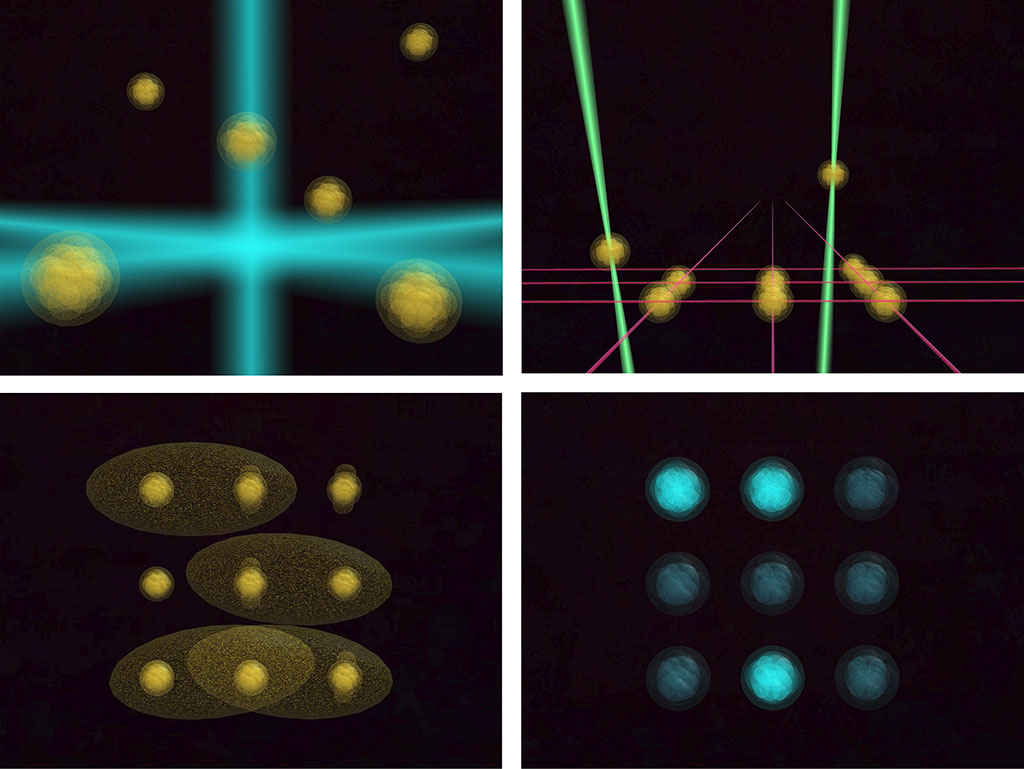
ParadoQc/Machines, Part 2: neutral atom quantum computing. Top left and right: blue laser
cooling, then infrared laser trapping lattice with green „optical tweezers“. Bottom left and right:
superposition and entanglement, then blue flouresence read-out of result.
Part 2 will be shown in future exhibits as a single,immersive AR livestream installation together with Part 1.
Many thanks to Prof. Dr. Steffen Glaser (TUM) and Prof. Dr. Johannes Zeiher (LMU, planqc), of the Munich Center for Quantum Science and Technology MCQST for their extremely generous time and patience as we peppered them with questions on the intimate details of quantum physics and quantum computing! (Note: All errors are exclusively the fault of the artists themselves!)